Marketing Lessons from the Street Market: When the Promise and Commercial Reality Share the Same Stall
Seven lessons from the street market on perceptible differentiation, diagnosis, trust, ease of buying and the value of the next sale.
Key takeaways
- Your difference needs to be perceptible and open to evaluation.
- The quality of the proposal starts with the quality of the diagnosis.
- Ease of buying and service capacity are part of the value.
- Today’s sale matters when it gives the customer a reason to return.
Before marketing filled up with English terminology, dashboards, funnels and AI agents, it existed in its purest, loudest and most unforgiving form every Saturday morning in the neighbourhood. There, among crates, scales and shouting, the only key performance indicator (KPI) that seemed to matter to a ten-year-old behind the stall in 1992 was leaving nothing in the crate.
At the street market, your competitor is three steps away. A customer can see your product, compare your price, ask you a question and buy from the next stall. All within a minute. That short distance drastically reduces the room to believe you are better just because your sign says so.
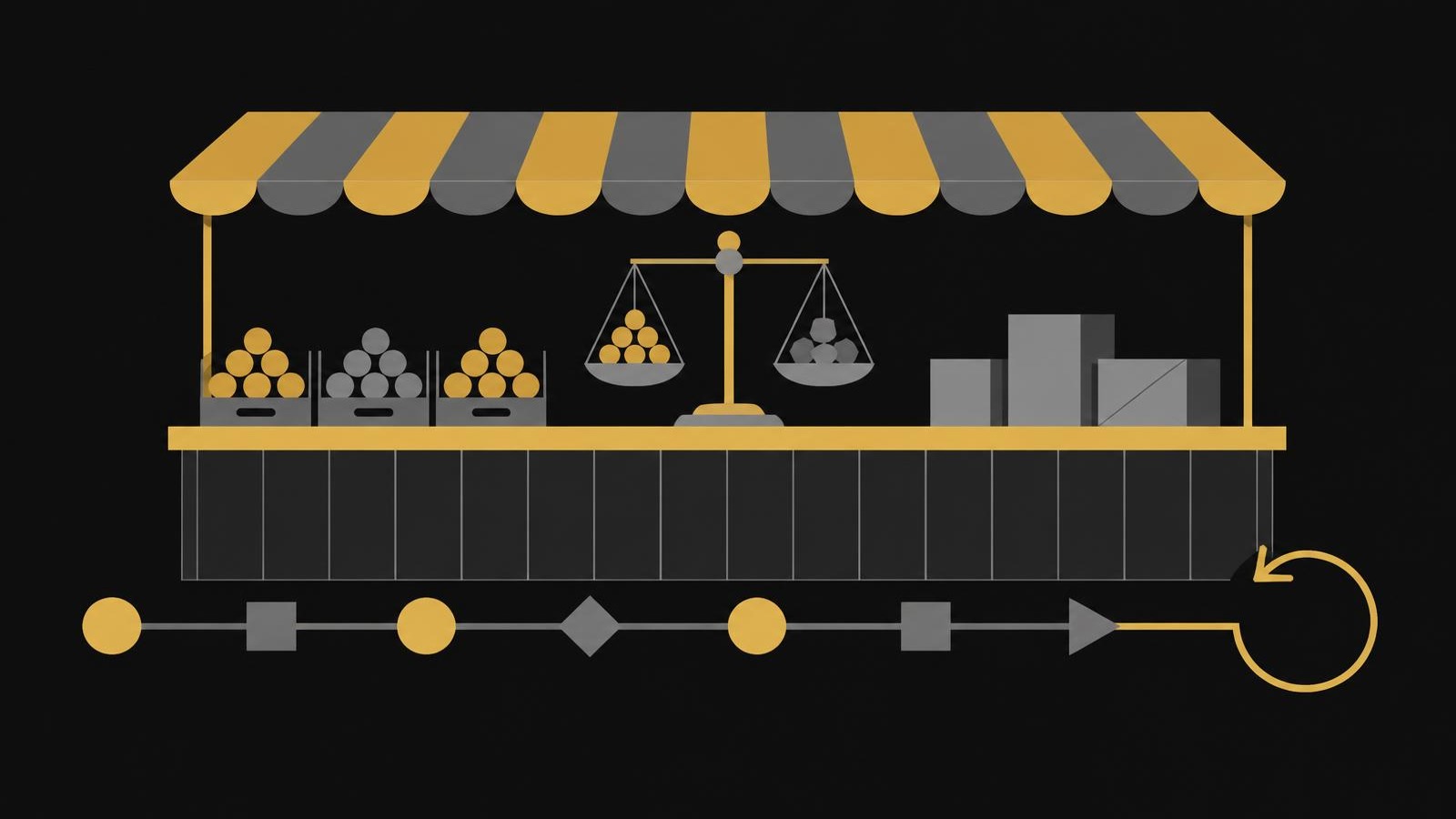
Within a few square metres, positioning, communication, pricing, service and reliability are tested simultaneously. The message is heard. The product is examined. The transaction happens or is lost. And the following week you can see whether the person who bought has a reason to return. That makes the street market a remarkable marketing lesson: the promise and commercial reality share the same stall.
1. Your difference must be perceptible (Positioning & the First Hook)
In the digital world, we fight for three seconds of attention during the scroll. At the street market, the battle starts with the voice. The seller’s call turns heads: the lawyer, the tradesperson, the new mother, the grandmother with her grandchildren all turn to see who is shouting. An honest smile brings them closer. But what keeps them there is perceived value.
Ten stalls in a row sell tomatoes. Almost everyone can shout “the best”, “the tastiest”, “hand-picked”. Yet those words struggle to distinguish anyone when everybody uses them. Customers need something they can understand and evaluate: a specific variety, origin, degree of ripeness, cultivation method or quality they recognise from a previous purchase.
Exactly the same happens when ten businesses claim “quality, innovation and excellent service”. The difference may genuinely exist within the business. But if customers cannot perceive it, it is unlikely to influence their choice. Price then gains importance because it is one of the few things that are easy to compare. Before concluding that “people only care about price”, examine how specifically you have shown them what else they are buying from you.
2. The right question changes the product you recommend (Diagnosis Before Selling)
“Do you want them for today, or to keep for later?”
Such a simple question can change the entire sale. A tomato that is ideal for today’s salad may be unsuitable for someone shopping for the end of the week. The product remains in the same category, but its value changes according to its use.
In business, we often describe our audience exhaustively and the circumstances in which they decide barely at all. We know ages, occupations and interests, but have not understood what the customer is trying to accomplish, what pressures them and which mistake they want to avoid.
A business owner asking for “more leads” may need immediate sales to use idle capacity. Another may already have enough enquiries, but from people they cannot serve profitably. The same service does not have the same value for both. The quality of the proposal always starts with the quality of the diagnosis.
3. Trust is earned when customers can check for themselves
Food quality has a particular feature: a significant part of it is revealed after you leave the stall. The fruit will be cut at home, its flavour judged at the table and its keeping quality revealed over the following days. The buyer pays before knowing the full result, which creates uncertainty.
How is this resolved at the stall? With an apple slice offered on the tip of a knife, the opportunity to examine the product and a precise, honest explanation. “These need eating today” strengthens credibility far more than another reassurance that everything is excellent. It shows that you help the other person buy well, even when that limits the immediate sale.
The same problem exists in consulting, software or working with an agency, where customers are asked to commit before experiencing the value. They need evidence they can evaluate: real samples, a clear process, case studies with specific context and honesty about limitations.
4. Ease of buying is part of the value (UX & Removing Friction)
Presentation matters. At the stall, you put the best at the front, neatly arranged, but never perfectly. When apples are stacked like a museum pyramid, nobody dares take the first one for fear of spoiling the display. People want to touch, not admire.
At the same time, customers may want your product and leave because buying it requires more effort than they are willing to make. An invisible price, a queue with no clear order, a simple question left unanswered or a delayed payment process: each of these small difficulties stands between intention and transaction.
Online, the same friction appears as unclear costs, a complicated contact form, a slow reply or an offer that takes three phone calls to explain. Before increasing demand, examine what happens to those already trying to buy. If the stall cannot serve them, a louder voice may simply lengthen the queue. Service capacity limits the value communication can create.
5. Today’s sale influences the next one (Entry Products & Ethical Upselling)
At the street market, you learn what an entry product is without knowing the term. Potatoes go at the front. The week’s table can manage without apples, but not without potatoes: ask any Greek mother. Customers come for two kilos of potatoes and leave with a kilo of apples too, because somewhere inside, with the right conversation, an apple pie has already started baking.
But a major trap lies here. Suppose you manage to sell someone more fruit than they can eat. The basket has grown and today’s transaction looks successful. A few days later, however, the customer throws half of it away and feels they were carried away. Your success was recorded in their memory as their bad purchase.
This is the risk of evaluating upselling solely by average order value (AOV). The extra sale needs to improve the outcome for the customer too. A suitable complementary recommendation, the apple pie, helps them. A larger quantity or a more expensive service package they do not need undermines the next purchase. “Take less, so it doesn’t spoil” may reduce today’s receipt, but gives customers a powerful reason to trust you again. If you measure only the transaction, it looks like a missed opportunity. If you track the relationship over time (LTV), it is an excellent investment.
6. A discount needs an economic reason
Anyone who cuts prices early in the morning at the street market to attract crowds ends the year with the biggest crowds and the least money.
A lower price towards the end of the day is entirely logical: perishable stock needs to be sold, and some of it will lose value if it returns unsold. The decision is connected to available stock, its shelf life, cost and remaining demand.
The same logic is needed in business. A discount for specific stock, a period of low demand or a targeted first trial has a different economic function from a permanent offer that simply covers your inability to explain your value. A full till and an empty stall are not enough to evaluate the day. You need to know what remains after accounting for product costs, transport, labour and losses. Sales growth gains business meaning only when you know the terms on which you bought it.
7. Contact with customers (and the ecosystem) matters when it changes your decisions
At the street market, you quickly learn that the next stall is not your enemy. When you run out of something, you send customers there to meet their need, and the following week that seller sends you two. Behind the stall, you also hear the pre-purchase question, the price objection and the complaint from last week directly. This proximity allows immediate adaptation: you change what you bring, how you present it, what you explain and which quantity you recommend.
In a larger business, this information is often scattered across different departments:
Marketing sees the response to the campaign.
Sales hears the objections.
Customer service receives the complaints.
Finance sees the profit margin.
Each holds part of the picture, but decision quality depends on whether those parts meet. You need a consistent way to examine together what attracts customers, what prevents them from buying and what disappoints them afterwards. A recurring question may lead to clearer communication; a frequent complaint may require changing the product itself. Listening to the market creates value only when something works differently because of what you heard.
Today we have CRM, funnels, AI agents and dashboards. We use them daily and they are valuable. But the street market lets us see the entire commercial journey at a human scale: the person who passes, stops, compares, asks, pays and finally uses what they bought.
In your business, that journey may pass through an advertisement, a website, a salesperson and a service team. Customers, however, experience all of it as one relationship with you.
Before asking for the next campaign, follow that journey. See where the promise becomes clear, where buying becomes difficult and what is actually delivered. The street market has simply changed stalls: marketing brings customers in front of you, but the entire business gives them a reason to return.
Tags
Share